
Free Printable Recipe Cards (4x6 PDF)

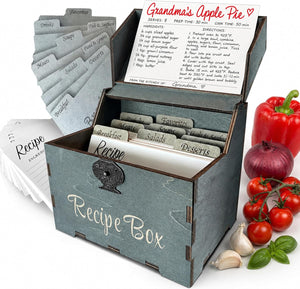
Albino monkey Wooden Recipe Box
Real wooden dividers and 100 blank 4x6 cards, printed both sides in this exact layout. Somewhere for the ones you print to live.
Twelve blank 4x6 recipe cards, laid out exactly like the cards inside our Recipe Box. Two cards per sheet, six sheets. Print it again whenever you want twelve more.
Both files open with a cover and a one page printing guide, so the cards themselves start on page 3. The guide tells you the exact page range to send to the printer.
Take the one that suits your printer
Download the double-sided cards
14 pages. Fronts and backs, so you get the ruled back for long methods and cooking notes. Print pages 3 to 14, flipped on the long edge.
Download the single-sided cards
8 pages. Fronts only. Nothing to set up, nothing to align, no double-sided settings to find. Print pages 3 to 8.
No email required. They are PDFs, they are free, and they stay free.
What is on each side
The front carries the recipe name, serves, prep time and cook time, then ingredients and method side by side, with from the kitchen of along the bottom. The back is ruled the full width of the card, for when the method runs longer than the front allows, which it usually does.
It is the same layout as the printed cards in the box, so a printed one and a boxed one sit in the same stack without looking like an afterthought.
The two things that ruin a print run
Full instructions are inside the PDF, but these are the two that cost people a pack of card stock:
- Scaling. Print at 100% and turn off fit to page. Anything less and the cards stop being 4x6, which means they stop fitting a recipe box.
- Short-edge flip. On the double-sided version, flip on the long edge. Short edge turns every back upside down.
Use card stock at 200gsm or heavier. Ordinary printer paper goes soft the first time you cook with wet hands, which is the only time a recipe card really matters.
Why 4x6 and not something else
4x6 is the standard for recipe cards in the same way A4 is standard for paper. It is the size every recipe box, tin and photo album is built around, and it is the size a card needs to be before it stops being useful: big enough for ingredients and method side by side, small enough to prop against a bowl.
If you write your recipes on index cards of some other size, you will eventually own a box that does not fit them.
How to organize family recipes so they survive
Most family recipes are lost the same way. They live in one person’s head, or on the back of an envelope in one person’s drawer, and then that person is gone.
What actually works is boring and effective:
1. Write it the way they say it
If your grandmother says “a knob of butter” and “until it looks right”, write that down. Do not translate it into grams. The imprecision is the recipe. You can add your own measurements underneath once you have made it a few times.
2. Put the name of the person on the card
“From the kitchen of” is not decoration. In twenty years it is the most valuable line on the card. Our template has that field at the bottom for exactly this reason.
3. Sort by meal, not by ingredient
People look for recipes by occasion. Breakfast, soups, desserts. Nobody stands in a kitchen thinking “what can I make with paprika”. Nine or ten dividers is enough.
4. Keep the failures
Write on the card when something goes wrong. “Too dry, use less flour.” A recipe card with cooking notes on it is worth ten clean ones. This is what the ruled back is for.
5. Do not put it in an app
We say this as a company with a website. Apps disappear when servers shut down and accounts get closed. A card in a box in a kitchen has already outlived several generations of software, and it works when the power is out.
When you outgrow printed cards
Printed cards work. What they lack is somewhere to live, which is how loose recipes end up in a drawer.
We make the Albino monkey® Wooden Recipe Box for that. Real wooden dividers, 100 blank 4x6 cards printed both sides in the same layout as the free PDF above, and a lid that closes. It is $27.99, down from $49.99 when we first sold it, and holds 4.6 stars from 90 ratings on Amazon.
Profit from it pays for the care of Freeman, a rescued albino monkey. That is where the money goes.
Want recipes to fill them with?
We publish hundreds, all free, sorted the same way the dividers are: breakfast, soups, salads, pasta, fish, meat, desserts and drinks. Every recipe page has a save button so you can build a box online before you build one on the counter.
Questions
Which version should I take?
The double-sided one if your printer does both sides. You get the ruled back, which is where long methods and cooking notes go. The single-sided one is the same front, no settings to change. Neither is better once it is cut out and sitting in a box.
My printer will not print both sides. What now?
Take the single-sided file. You can also open the double-sided one and print only the odd pages from 3 onwards, which gives you the same result the long way round.
Why does the PDF start with a cover?
So you can see what you are getting before you spend ink on it. Pages 1 and 2 are the cover and the printing guide. Start printing at page 3 and you will never print either of them.
Can I share the PDF?
Yes. Send it to whoever you like. We would rather it spread than sit here.
Can I use these commercially?
No. Personal and family use is fine and encouraged. Selling them, or printing them into a product you sell, is not.
Will they fit my existing recipe box?
If your box takes standard 4x6 cards, yes. Print at 100% and do not let your printer scale them.
