
Best Sushi Making Kit for Beginners (2026)

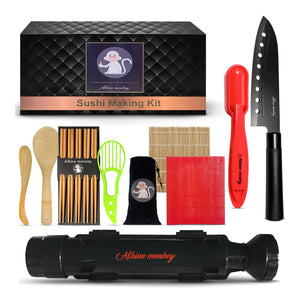
Albino monkey Sushi Making Kit
20-piece set with bazooka, sashimi knife, two rolling mats and a free 15-lesson video course. Everything but the fish.
Last updated August 2026. Written by the team at Albino-monkey.com. We make one of the kits reviewed below, and we say so plainly wherever it comes up.
Most people who want to make sushi at home give up at the rice. Not because it is hard, but because they bought a bag of tools that does not include the one thing that actually matters, and the roll falls apart on the first cut.
This guide is what we would tell a friend. What a beginner kit needs, what is filler, and how to tell the difference before you spend money.
What actually matters in a beginner kit
1. A rolling mat you can clean
Every kit has a bamboo mat. The difference is whether the bamboo is sealed. Unsealed mats absorb rice starch and vinegar, and after three or four uses they smell. Look for round-rod bamboo rather than flat slats, and plan to wrap it in cling film the first few times anyway. Two mats is better than one, because you will want a dry one halfway through.
2. Something that solves the rice problem
This is where beginners fail. Spreading sushi rice evenly by hand takes practice, and uneven rice is why rolls burst. A rice mold or a tube-style roller removes that skill requirement entirely on your first attempt. If a kit does not include one, you are buying a mat and some chopsticks.
3. A knife that is actually sharp
A blunt knife tears a roll rather than cutting it. You do not need a 300 dollar sashimi knife, but you do need a long, thin blade. Most kits include something adequate. If yours does not, a wet chef's knife works better than a bad sashimi knife.
4. A paddle and spreader
Wooden or plastic, it does not matter much, as long as it is not metal. Metal reacts with the rice vinegar and dulls the flavor. These are cheap and every reasonable kit includes them.
What is filler
- Novelty molds in shapes. Hearts, stars, animals. They look good in the product photo. You will use them once.
- Piece counts that count each chopstick separately. A "32 piece kit" is often 10 useful items and 22 pieces of the same thing. Read the actual list.
- Recipe booklets. Every kit includes one. They are all thin. Free guides online, including ours, go further.
- Bamboo chopsticks you will throw away. Fine if included. Not a reason to choose a kit.
Our pick, and our disclosure
We make the Albino monkey® Sushi Making Kit, so treat this as our recommendation rather than an impartial verdict. Everything above is how we would judge any kit, including ours.
It is a 14 piece set built around the two things beginners get stuck on: the rice and the roll. It includes the tube-style bazooka that solves even rice distribution, a sashimi knife, two bamboo mats rather than one, a paddle, a spreader, a nigiri mold, reusable chopsticks, an avocado slicer and a storage bag.
On Amazon it holds 4.3 stars across 293 ratings at $23.99, down from an original $49.99.
See the Sushi Making Kit on Amazon
Profit from every sale pays for the care of Freeman, a rescued albino monkey. That is what the money is for.
Should you buy a kit or the pieces separately?
Buy separately if you already own a good knife and know you will use this often. A quality mat and a decent rice paddle cost very little on their own.
Buy a kit if this is your first attempt. Not for the savings, which are modest, but because a kit removes the decision fatigue of buying five things you cannot yet evaluate. You will find out within two sessions whether sushi is going to be a habit or a phase. Twenty four dollars is a reasonable price for that answer.
What to do on your first night
- Make the rice the day you are going to eat it. Refrigerated sushi rice goes hard and will not stick. This is the single most common mistake.
- Start with a cucumber and avocado roll. No raw fish on night one. You are learning the mechanics, not the seafood.
- Wet your hands constantly. A bowl of water with a splash of rice vinegar next to you. Rice sticks to dry skin and to nothing else.
- Cut with a wet blade, one stroke, no sawing. Wipe and re-wet between cuts.
Our full walkthrough is free: How to Make Sushi at Home, step by step. There is also a library of sushi recipes once you have the basics.
Common questions
Do I need special rice?
Yes. Short grain Japanese rice, sold as sushi rice or koshihikari. Long grain will not hold together no matter what tools you own. This matters more than any item in any kit.
Is raw fish safe to make at home?
Buy fish labeled for raw consumption, sometimes called sushi grade, from a fishmonger you trust, and use it the same day. If you are unsure, there is no shame in cooked shrimp, smoked salmon or vegetables. Most sushi eaten in Japan is not raw.
How long does it take the first time?
Budget ninety minutes including the rice. By the third time you will be at thirty.
Can children use a kit?
The rolling is genuinely good with children. The knife is not. Roll together, cut yourself.
The short version
Ignore piece counts. Check for a rice solution, sealed bamboo, and a blade with some length. If a kit has those three, it will get you through your first night, and your first night is the only thing standing between you and finding out whether you like this.
