

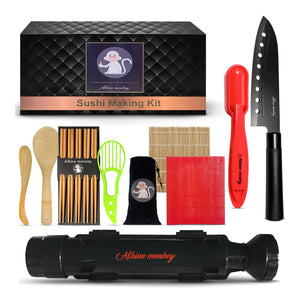
Sushi Making Kit
20-piece set with bazooka, sashimi knife, two rolling mats and a free 15-lesson video course. Everything but the fish.

Home / Sushi Recipes / Sushi Course

How to Make Sushi at Home
Making sushi is easier than you think
Welcome to our step-by-step sushi course. 🍣 Learn how to make the different types of sushi, test your knowledge with the questions along the way, and check your answers at the bottom. Ready? Let us roll. 🥢
Lesson 1
Watch it in action 🎥
See just how easy and fun it is to make fresh sushi at home with the Albino Monkey Sushi Making Kit.
Love what you see? Make sushi nights easy and fun. Grab your own Sushi Making Kit here.
Lesson 2
What you need to make sushi at home 🥢
Before you start rolling, make sure you have the right essentials. With just a few simple tools and ingredients, anyone can create restaurant-quality sushi at home.
Ingredients list:
- Sushi rice (shari) - the heart of every roll. Short-grain, sticky rice seasoned with rice vinegar, sugar, and salt.
- Nori sheets (seaweed) - the wrapper that holds everything together.
- Fresh fillings - salmon, tuna, shrimp, cucumber, avocado, and endless possibilities.
- Optional extras - soy sauce, wasabi, and pickled ginger for the perfect finish.
The Albino Monkey Sushi Making Kit includes everything you need, except the fresh ingredients, from mats and bazooka to a professional sashimi knife.
Lesson 3
Sushi rice, the heart of every roll 🍚
It all begins with the rice. The word sushi actually refers to the seasoned rice, not the fish. Getting the rice right is the key to sushi that tastes authentic and holds together properly.
Sushi rice (shari) is not just plain white rice. Short-grain Japanese rice contains more starch than long-grain varieties, which makes it slightly sticky and perfect for holding rolls together. Too much starch makes it gummy, so rinsing is essential. The seasoning mix (sushizu), a blend of rice vinegar, sugar, and salt, also lowers the pH of the rice, which historically helped preserve raw fish. The glossy look comes from gently folding in the seasoning without crushing the grains.
How to make perfect sushi rice
- Rinse - wash the short-grain rice in cold water several times until the water runs clear. This removes excess starch.
- Cook - use a rice cooker or pot with the right water ratio, about 1 to 1.2 rice to water.
- Season - while the rice is still warm, gently fold in the rice vinegar, sugar, and salt mixture.
- Cool - spread the rice in a shallow bowl to cool slightly before using. Do not refrigerate, it makes the rice too hard.
Pro tip: never mash or stir too hard. Use a gentle slicing and folding motion to keep the grains shiny and separate.
Lesson 4
Types of sushi you can make at home 🍣
- Nigiri - a small mound of rice topped with fresh fish or seafood. Simple, elegant, and very popular.
- Maki - classic rolls wrapped in nori and sliced into bite-size pieces. Perfect for beginners.
- Hosomaki - a slim roll with just one filling, like cucumber, salmon, or tuna.
- Futomaki - larger rolls filled with multiple ingredients for colorful slices.
- Uramaki - inside-out rolls with rice on the outside and nori inside, like the California roll.
- Temaki - cone-shaped hand rolls, easy to hold and eat by hand.
- Sashimi - thin slices of raw fish without rice. A true test of knife skills.
- Gunkan - oval rice wrapped in nori and topped with soft ingredients like roe.
- Chirashi - a colorful bowl of sushi rice topped with assorted sashimi and vegetables.
- Inari - sweet and savory pockets of fried tofu stuffed with rice. A vegetarian favorite.
🍣 Question 1: What type of sushi do we learn to make in the video?
1. Nigiri 2. Maki Roll 3. Sashimi
Lesson 5
Nigiri, the easiest sushi to start with 🍣
Nigiri is the simplest type of sushi and the perfect place to begin. It is made by shaping a small ball of sushi rice by hand and gently placing a slice of fresh fish, like salmon or tuna, on top. No rolling mats, no fancy tricks, just rice, fish, and your hands.

How to make nigiri with the Nigiri Maker tool
- Prepare the rice - cook and season short-grain sushi rice, then let it cool slightly.
- Fill the Nigiri Maker - lightly wet the inside of the tool and add a spoonful of rice to each slot.
- Press gently - close the press to shape the rice into uniform nigiri bases.
- Add the topping - remove the rice pieces and place a slice of fresh fish neatly on top.
- Finish and serve - brush a little soy sauce over the fish, or add a dab of wasabi between the rice and topping.
In just minutes you have restaurant-quality nigiri, no hand-rolling skills required.
🍣 Question 2: Shaping the rice evenly can be tricky. Which tool in the kit is designed to help?
1. Sushi Rolling Mat 2. Sushi Bazooka 3. Nigiri Maker Tool
Lesson 6
Maki, classic sushi rolls anyone can make 🥢
Maki is the sushi style most people picture first: rice and fillings wrapped in nori, rolled tightly, and sliced into bite-size pieces. Use the bamboo rolling mat for the traditional approach or the Sushi Bazooka for a faster, foolproof roll. If you use the Bazooka, watch the step-by-step video in Lesson 1.

How to make maki
- Place a sheet of nori shiny-side down on your bamboo mat.
- Spread a thin, even layer of seasoned rice over the nori, leaving a small edge free.
- Add fillings like salmon, cucumber, avocado, or crab.
- Roll it up firmly with the bamboo mat.
- Slice into even pieces with the sashimi knife.
Pro tip: dip the knife in water before cutting. It keeps the rice from sticking and gives clean slices.
Lesson 7
Hosomaki, thin and elegant rolls 🌱
Hosomaki is a small, delicate roll with just one filling, like cucumber, tuna, or avocado. Because it is thinner than regular maki, it is great for practice and for light, elegant bites.

How to make hosomaki
- Place half a sheet of nori on your mat, shiny-side down.
- Spread a thin layer of rice, leaving about 2 cm uncovered at the top.
- Add a single strip of filling in the center.
- Roll tightly with gentle, even pressure.
- Slice into 6 to 8 small pieces.
Pro tip: keep the rice layer very thin. Less rice means easier rolling and a better shape.
🍣 Question 3: Which sushi is known for using just one simple filling, like cucumber or tuna?
1. Hosomaki 2. Futomaki 3. Uramaki
Lesson 8
Futomaki, big, bold and colorful rolls 🌈
Futomaki means thick roll, and it is packed with flavor and color. Unlike hosomaki, it combines three or more ingredients, like salmon, egg, cucumber, avocado, or pickled vegetables, in a large sheet of nori.

How to make futomaki
- Place a full sheet of nori on your mat.
- Spread an even layer of rice, leaving 1 to 2 cm free at the top.
- Arrange a variety of fillings in the center. Do not overfill.
- Roll up, pressing gently but firmly for a compact roll.
- Slice into 8 thick pieces with a wet knife.
Pro tip: balance textures and colors. Combine something crunchy like cucumber with something creamy like avocado and a protein like salmon.
Lesson 9
Uramaki, inside-out sushi rolls ✨
Uramaki flips tradition inside-out: the rice goes on the outside, the nori hides inside around the fillings. This style is popular in the West, with the California roll being the most famous example.

How to make uramaki
- Place nori on the bamboo mat and cover with an even layer of rice.
- Sprinkle sesame seeds or fish roe on top for flavor and crunch.
- Flip the nori so the rice is now on the outside.
- Add fillings such as crab, avocado, and cucumber in the center.
- Roll carefully with gentle pressure.
- Slice into even pieces with a wet knife.
Pro tip: use plastic wrap on your mat to keep rice from sticking when rolling inside-out.
Lesson 10
Temaki, fun and easy hand rolls 🌯
Temaki means hand roll, and it is one of the most fun styles to make at home. Instead of a mat, you shape the nori into a cone, fill it with rice, fish, and vegetables, and eat it by hand. Casual, customizable, and perfect for sushi night with friends or family.

How to make temaki
- Cut a nori sheet in half.
- Place a small amount of rice on one side, leaving the edges free.
- Add fillings diagonally across the rice.
- Roll the nori into a cone, sealing the edge with a few grains of rice.
- Serve immediately while the nori is still crisp.
Pro tip: temaki is best made fresh at the table so everyone can build their own.
🍣 Question 4: Which sushi is rolled into a cone and eaten by hand?
1. Hosomaki 2. Temaki 3. Nigiri
Lesson 11
Sashimi, pure and elegant slices of fish 🐟
Sashimi is not technically sushi, since there is no rice, but it is always part of the experience. It is all about fresh, high-quality fish sliced into thin, perfect pieces. With the sashimi knife in the kit, you can get clean, restaurant-style cuts at home.

How to make sashimi
- Choose fresh, sushi-grade fish such as salmon or tuna.
- Place the fish on a board and hold it firmly.
- Slice at a slight angle into thin, even pieces.
- Arrange on a plate with wasabi and soy sauce on the side.
Pro tip: use long, smooth strokes instead of sawing back and forth. This gives sashimi its clean edges.
🍣 Question 5: Which roll has the rice on the outside and the nori inside?
1. Futomaki 2. Uramaki 3. Hosomaki
Lesson 12
Gunkan, the battleship sushi 🚢
Gunkan, or gunkanmaki, means battleship because of its shape. A small oval of rice is wrapped with a strip of nori, leaving space at the top for soft or loose toppings like fish roe, sea urchin, or chopped tuna.

How to make gunkan
- Shape a small oval of rice by hand or with the Nigiri Maker tool.
- Wrap a strip of nori around the sides, letting it rise above the rice.
- Spoon in toppings like salmon roe, spicy tuna, or avocado mix.
- Serve immediately for the freshest flavor and texture.
Pro tip: use a few grains of rice as glue to seal the nori strip and keep the gunkan neat.
Lesson 13
Chirashi, the colorful sushi bowl 🎨
Chirashi means scattered sushi, and it is one of the easiest ways to enjoy sushi flavors at home. Instead of rolling or shaping, you serve sushi rice in a bowl and scatter a variety of toppings over it.

How to make chirashi
- Prepare a bowl of seasoned sushi rice as the base.
- Add toppings like sliced sashimi, avocado, cucumber, tamago, and vegetables.
- Garnish with sesame seeds, nori strips, or pickled ginger.
- Serve with soy sauce or wasabi on the side.
Pro tip: chirashi is perfect for sharing. Let everyone build their own bowl.
Lesson 14
Inari, sweet and savory tofu pockets 🥢
Inari sushi is one of the easiest and most unique styles. Instead of seaweed, the rice is wrapped inside a pouch of fried tofu (inari-age) simmered in a sweet and savory sauce. The result is a soft, juicy pocket filled with sushi rice, and it is vegetarian-friendly.

Fun fact: Inari is also the name of a town in Finnish Lapland.
How to make inari
- Prepare sushi rice and let it cool slightly.
- Open the tofu pouches carefully so they do not tear.
- Fill each pouch with rice, pressing gently so they hold their shape.
- Serve as they are, or garnish with sesame seeds or chopped vegetables.
Pro tip: do not overfill the pockets. A little space at the top keeps the shape neat.
Great work. You have now covered all ten sushi types: nigiri, maki, hosomaki, futomaki, uramaki, temaki, sashimi, gunkan, chirashi, and inari.
Lesson 15
Bring sushi night home 🍣
You have explored the world of sushi, from simple nigiri and classic maki to colorful futomaki, elegant sashimi, fun temaki cones, and unique styles like chirashi bowls and inari pockets. Sushi is a creative experience that brings people together, and you do not need to be a professional chef to make it at home.
With the Albino Monkey Sushi Making Kit you get everything in one box: bamboo mats, a sushi bazooka, sashimi knife, chopsticks, nigiri maker, avocado slicer, and more. It is designed for beginners but delivers results seasoned sushi lovers will appreciate. Making sushi at home is easier, healthier, and more affordable than going out.
🍣 Question 6: What makes temaki different from regular maki rolls?
1. Temaki is rolled into a cone instead of a cylinder 2. Temaki uses tofu pockets instead of nori 3. Temaki is sliced into small pieces before serving
🍣 Final question: What is the true foundation of sushi, no matter which style you make?
1. Fresh fish and toppings 2. Sushi rice (shari) prepared with vinegar, sugar, and salt 3. The tools like mats, bazookas, and knives
👉 Get your Sushi Making Kit here and turn your kitchen into a sushi bar tonight.
Check your sushi knowledge
Question 1: 2 - Maki Roll 🎉
Question 2: 3 - Nigiri Maker Tool 🎉
Question 3: 1 - Hosomaki 🎉
Question 4: 2 - Temaki 🎉
Question 5: 2 - Uramaki 🎉
Question 6: 1 - Temaki is rolled into a cone 🎉
Final question: 2 - Sushi rice 🍚
Sushi questions, answered
- What kind of rice do I use for sushi?
- Short-grain Japanese sushi rice, rinsed until the water runs clear, then seasoned with rice vinegar, sugar, and salt. Long-grain rice is too dry and will not hold together.
- Is the fish in sushi raw, and is it safe to eat?
- Some sushi uses raw sushi-grade fish, but many popular rolls are not raw at all, such as the California roll, cucumber roll, and shrimp tempura roll. If you do use raw fish, buy sushi-grade, keep it cold, and use it the same day.
- Can I make sushi without a bamboo mat?
- Yes. A clean kitchen towel wrapped in plastic wrap works in a pinch, and the Sushi Bazooka in the kit rolls tight maki with no mat at all.
- What is the easiest sushi for beginners?
- Start with a California roll or a simple cucumber hosomaki, or make nigiri with the Nigiri Maker tool. None of these need advanced knife skills.
- What do I need to make sushi at home?
- Sushi rice, nori sheets, your fillings, a rolling mat or bazooka, and a sharp knife. The Albino Monkey Sushi Making Kit includes the tools, so you only add the fresh ingredients.
- How long does it take to make sushi at home?
- About 30 to 45 minutes once the rice is cooked and cooled. The rice is the slowest part, so start it first.
Roll your own tonight
The 14-in-1 Sushi Making Kit has the mats, bazooka, sashimi knife, nigiri maker, and more - everything in this guide, in one box.

